Essence of Africa 2026 in Zanzibar Essence of Africa is a trade forum, which means…
Rwanda Eco Accommodations: A Complete Guide to Sustainable Lodges and Camps
This guide covers Rwanda Eco Accommodations across its major destinations, Volcanoes National Park, Akagera National Park, Nyungwe Forest and Lake Kivu, explaining specifically what makes each eco-conscious rather than simply marketed that way, and how to evaluate a property’s environmental and community credentials before booking.
Rwanda has positioned itself deliberately as a high-value, conservation-first tourism destination, and this philosophy runs directly through its accommodation sector. A meaningful proportion of the country’s most celebrated lodges are built around ecological restoration, community ownership, or measurable conservation funding models, rather than sustainability being an afterthought or marketing layer applied to a standard luxury property.
Bisate Lodge’s reforestation of a former agricultural amphitheatre, Singita Kwitonda’s forest corridor expansion project, and Sabyinyo Silverback Lodge’s direct community equity structure are not exceptions in Rwanda’s tourism landscape; they represent the model the country has actively encouraged its lodge sector to follow.
Why Eco-Accommodation Matters in Rwanda Specifically
Rwanda’s tourism model links conservation funding directly to visitor spending in a way that’s more explicit than in most African safari destinations. Gorilla trekking permit revenue funds ranger patrols and community revenue-sharing. Akagera’s accommodation partners contribute to the park’s anti-poaching and species reintroduction programmes. Nyungwe’s lodges support ongoing rainforest research and community development. Choosing accommodation with environmental and community credentials, rather than simply the most polished marketing, means your spending more directly supports the conservation outcomes that make Rwanda’s wildlife recovery possible.
This matters practically too: properties with ecological design, passive cooling, local sourcing, water and waste management appropriate to their remote settings, tend to also deliver a more authentic sense of place than a generic luxury lodge that could exist anywhere. Understanding which Rwanda properties embody this rather than simply using the language of sustainability helps travellers make a more informed accommodation choice.
What Makes a Rwanda Lodge Eco-Conscious
The clearest signal of a eco-accommodation in Rwanda is a measurable conservation or community outcome tied directly to the property’s operation, rather than a general sustainability statement. Bisate Lodge’s reforestation project, which has restored native forest across a former agricultural amphitheatre on the slopes of Mount Bisoke since the property opened, is trackable and specific: a defined area of degraded land converted back to forest habitat that extends the buffer zone around Volcanoes National Park. Singita Kwitonda’s forest corridor project works on a similar principle, aiming to reconnect fragmented forest habitat to the national park boundary over time, directly expanding the available range for the mountain gorilla population.
Community ownership structures represent a second model. Sabyinyo Silverback Lodge is partly owned by the local landowners whose land the property occupies, giving them a direct equity stake in the lodge’s success rather than simply employment or a land lease payment. This structural difference, ownership rather than only employment, is a meaningfully deeper form of community benefit than a lodge that simply employs local staff or sources some local produce.
Akagera’s accommodation partnerships operate on a different but equally substantive model: properties like Magashi Safari Camp and Ruzizi Tented Camp contribute directly to African Parks’ management of Akagera, the same organisation responsible for the park’s remarkable lion and rhino reintroduction programme, meaning accommodation revenue at these properties has a documented link to the specific conservation outcomes that have made Akagera’s Big Five recovery possible.
Rwanda’s Leading Eco-Accommodations by Model
Here is a direct comparison of Rwanda’s most significant eco-accommodations and the specific model each follows.
| Property | Location | Eco Model | What It Funds |
| Bisate Lodge | Volcanoes National Park | Habitat restoration | Reforestation of a former agricultural amphitheatre, expanding gorilla habitat buffer |
| Singita Kwitonda Lodge | Volcanoes National Park | Forest corridor expansion | Reconnecting fragmented forest to extend the gorilla range |
| Sabyinyo Silverback Lodge | Volcanoes National Park | Community equity ownership | Direct profit-sharing with local landowners as lodge co-owners |
| Magashi Safari Camp | Akagera National Park | Conservation partnership | Contributes to African Parks’ Akagera management, including anti-poaching and reintroduction |
| One&Only Nyungwe House | Nyungwe Forest | Rainforest research support | Supports Nyungwe conservation and community development programmes |
| Amajambere Iwacu Community Camp | Near Mgahinga (Uganda border area) | Community-owned lodge | Revenue directly funds local community development projects |
Rwanda’s Key Eco-Accommodations by Destination
What follows covers the most significant eco-conscious properties across Rwanda’s main destinations in detail.
Volcanoes National Park: Bisate Lodge
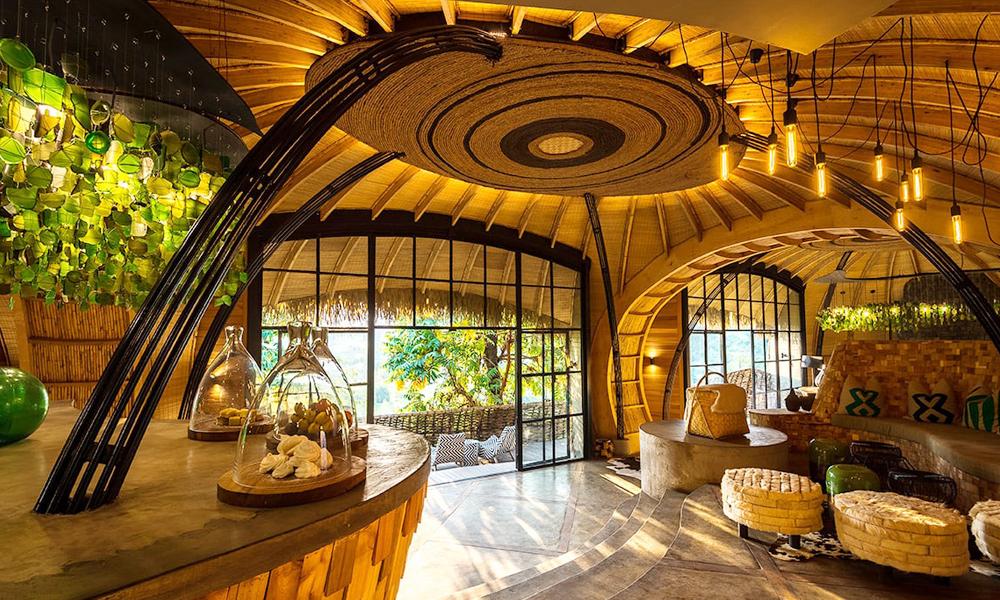
Bisate Lodge sits within a restored natural amphitheatre on the slopes of Mount Bisoke, and its six spherical, thatched villas are built in a style that echoes traditional Rwandan royal palace architecture. Since opening, the lodge has run an active reforestation programme across the surrounding hillside, converting what was previously degraded agricultural land back into native forest, directly expanding the buffer habitat available to the mountain gorilla population in the adjacent national park. This is among the most frequently cited examples of ecological restoration tied to a luxury lodge anywhere in Africa.
Volcanoes National Park: Singita Kwitonda Lodge
Singita Kwitonda Lodge takes a quieter but similarly substantive approach, working to restore and reconnect a forest corridor between the lodge’s grounds and the national park boundary. The stated aim is to expand the gorillas’ available range over time by reducing habitat fragmentation, a long-term conservation investment rather than a marketing gesture, consistent with Singita’s broader conservation reputation across its African portfolio.
Volcanoes National Park: Sabyinyo Silverback Lodge
Sabyinyo Silverback Lodge was among the first luxury properties near Volcanoes National Park and remains distinctive for its community ownership structure, with local landowners holding a direct equity stake in the lodge rather than simply leasing land or receiving employment income. This structural arrangement gives the surrounding community a lasting financial interest in the lodge’s continued success and, by extension, in the conservation tourism model that supports it.
Akagera National Park: Magashi Safari Camp
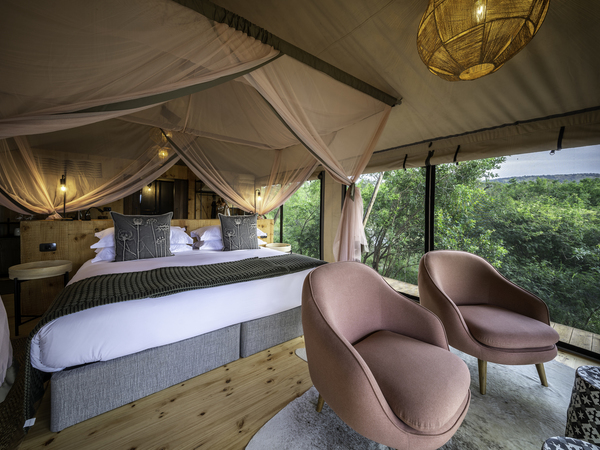
Magashi Safari Camp, in Akagera’s northern sector, operates as part of the broader conservation partnership between the Rwanda Development Board and African Parks, the organisation responsible for Akagera’s remarkable recovery, including the reintroduction of lions in 2015 and both black and white rhino in subsequent years. Accommodation revenue at Magashi contributes directly to this management structure, funding the ranger patrols and anti-poaching operations that have kept Akagera free of elephant, lion and rhino poaching for over a decade.
Akagera National Park: Ruzizi Tented Camp
Ruzizi Tented Camp, near Lake Ihema, operates on a similar conservation-linked model, with its position and design specifically intended to minimise environmental footprint while giving guests convenient access to the park’s boat cruise and southern game drive circuits. Public campsites within the park, including Shakani, Muyumba and Mutumba, offer a more budget-accessible way to support the same conservation funding structure at a considerably lower accommodation cost.
Nyungwe Forest: One&Only Nyungwe House
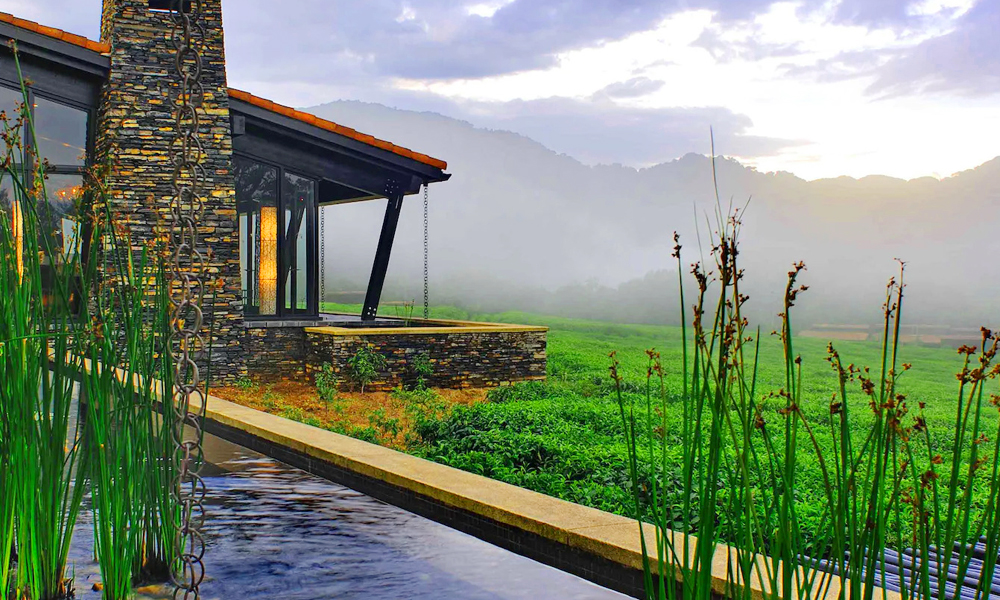
One&Only Nyungwe House sits on the edge of Africa’s oldest rainforest and supports ongoing conservation research and community development programmes connected to the forest’s protection. Nyungwe’s status as one of the most significant biodiversity hotspots in Africa, holding over 1,000 plant species and around 310 bird species, gives particular weight to accommodation partnerships that fund its continued research and protection.
Lake Kivu: Community and Small-Scale Properties
Lake Kivu’s accommodation sector includes a number of smaller, locally owned guesthouses and lodges around Rubavu, Karongi and Rusizi that, while less internationally marketed than the premium gorilla trekking lodges, channel a considerably higher proportion of revenue directly into the local economy than larger international-brand properties. Travellers specifically prioritising community economic benefit over polished luxury credentials should consider these smaller lakeside options.
When to Visit Rwanda’s Eco-Lodges
Rwanda’s eco-accommodations operate year-round, and none carry a specific seasonal eco-consideration beyond the standard climate patterns that affect any Rwanda visit. The dry seasons, June through September and December through February, remain the most popular booking windows and consequently the times when the most sought-after eco-lodges, particularly Bisate and Singita Kwitonda, are hardest to secure without advance booking.
Travellers specifically interested in seeing active reforestation or conservation work in progress, such as a guided walk through Bisate’s restoration project, may find the wetter months, when planted areas show the most visible growth, a particularly interesting time to visit, though this shouldn’t be the primary driver of trip timing given the more significant considerations around gorilla trekking permit availability and general trail conditions.
| Season | Months | Booking Pressure at Eco-Lodges | Considerations |
| Long dry season | June – September | Highest; book 6-12 months ahead | Peak season for the most sought-after properties like Bisate |
| Short dry season | December – February | Very high, especially over holidays | Book well ahead for Christmas and New Year |
| Long rains | March – May | Lower; often reduced rates | Good visibility of active reforestation growth at properties like Bisate |
| Short rains | October – November | Moderate | Good value shoulder season |
What Do Rwanda’s Eco-Accommodations Cost?
Rwanda’s most celebrated eco-lodges, Bisate, Singita Kwitonda and Sabyinyo Silverback Lodge among them, sit at the premium end of the country’s accommodation spectrum, reflecting both their design and service quality and the conservation investment their rates help fund. This premium positioning is consistent with Rwanda’s overall high-value, low-volume tourism philosophy.
eco-credentials are not, however, exclusively a luxury-tier phenomenon in Rwanda. Community-owned camps and public campsites, particularly at Akagera, offer meaningfully lower-cost ways to support conservation-linked accommodation, and smaller Lake Kivu guesthouses often channel a higher proportion of revenue to the local economy than larger branded properties despite their lower price point.
Budget eco-accommodation — Community camps and public campsites
Akagera’s public campsites and community-run camps like Amajambere Iwacu near Mgahinga offer conservation and community benefit at the most accessible price point in Rwanda’s eco-accommodation landscape.
Mid-range eco-accommodation — Ruzizi Tented Camp, smaller Lake Kivu lodges
Properties with clear conservation partnerships or strong local ownership at a considerably more accessible price point than the flagship luxury lodges, delivering impact without premium pricing.
Premium eco-accommodation — Bisate Lodge, Singita Kwitonda, Sabyinyo Silverback Lodge, Magashi Safari Camp
Rwanda’s flagship conservation-linked luxury properties, combining exceptional design and service with substantive, measurable environmental and community outcomes.
Comparing Rwanda’s Eco-Accommodations by Destination
Here is a direct destination-by-destination comparison to help match your itinerary to the right eco-conscious property.
| Destination | Standout Eco-Property | Model | Price Tier |
| Volcanoes National Park | Bisate Lodge | Habitat reforestation | Luxury |
| Volcanoes National Park | Singita Kwitonda Lodge | Forest corridor restoration | Luxury |
| Volcanoes National Park | Sabyinyo Silverback Lodge | Community equity ownership | Upper mid-range to luxury |
| Akagera National Park | Magashi Safari Camp | Conservation management partnership | Luxury |
| Akagera National Park | Public campsites (Shakani, Muyumba, Mutumba) | Direct conservation fee contribution | Budget |
| Nyungwe Forest | One&Only Nyungwe House | Rainforest research support | Luxury |
| Lake Kivu | Smaller locally owned guesthouses | Direct local economic benefit | Budget to mid-range |
How to Evaluate a Lodge’s Eco-Credentials
Beyond taking a property’s marketing at face value, a few specific questions and checks help distinguish eco-accommodation from surface-level sustainability language.
Ask About Specific, Measurable Outcomes
A eco-lodge should be able to describe a specific, measurable conservation or community outcome tied to its operation, a defined area of reforestation, a specific community ownership percentage, a documented partnership with a named conservation organisation, rather than a general statement about sustainability or environmental values.
Check for Structural Community Ownership
Community equity ownership, as at Sabyinyo Silverback Lodge, represents a structurally deeper form of local benefit than employment alone. Asking whether and how local communities have an ownership stake, rather than simply staff positions, is a useful distinguishing question.
Look for Named Conservation Partnerships
Properties linked to conservation funding, such as Akagera’s camps working alongside African Parks, or Bisate and Singita Kwitonda’s specific reforestation projects, will typically be able to name the specific organisation or programme their operation supports, rather than describing a vague general commitment to conservation.
Consider the Full Range, Not Just Premium Options
eco-credentials exist across Rwanda’s price spectrum, and travellers on a more modest budget shouldn’t assume that only premium properties offer meaningful conservation or community benefit. Akagera’s public campsites and community-run camps near Mgahinga demonstrate that budget-tier accommodation can carry equally credentials.
| Evaluation Question | What a Good Answer Looks Like | Red Flag |
| What specific conservation outcome does this property fund? | A named, measurable project (e.g. specific hectares reforested) | Vague statements about ‘sustainability’ with no specifics |
| Does the local community have an ownership stake? | A specific equity percentage or defined revenue-sharing structure | Only general claims of ‘supporting the community’ |
| Is there a named conservation partner organisation? | A specific, verifiable organisation (e.g. African Parks) | No named partner or verifiable link |
| Is this only available at the premium tier? | No; models exist from budget campsites to luxury lodges | Assuming eco-credentials require luxury pricing |
Planning a Rwanda Trip Around Eco-Accommodation
For travellers specifically prioritising eco-conscious accommodation across a multi-destination Rwanda trip, it’s possible to maintain this priority throughout: Bisate, Singita Kwitonda or Sabyinyo Silverback Lodge at Volcanoes National Park, Magashi Safari Camp or a community camp at Akagera, and One&Only Nyungwe House or a similar conservation-linked property at Nyungwe together give a consistent eco-focused circuit.
Booking the most sought-after eco-lodges, particularly Bisate, requires the same advance planning as any premium Rwanda property, six to twelve months ahead for peak season dates, given both high demand and the strict gorilla trekking permit limits that typically anchor a Volcanoes National Park stay.
For budget-conscious travellers, Akagera’s public campsites and community-run camps offer a way to maintain an eco-conscious focus without premium pricing, and it’s worth discussing this specifically with your operator rather than assuming eco-credentials are exclusively a luxury-tier consideration.
Eco-Accommodation by Traveller Priority
Here is a direct guide to which Rwanda eco-accommodations best match specific traveller priorities.
| Priority | Recommended Property | Why |
| Habitat restoration story | Bisate Lodge | Directly funds reforestation of gorilla habitat buffer |
| Community equity ownership | Sabyinyo Silverback Lodge | Local landowners hold a direct equity stake |
| Named conservation organisation partnership | Magashi Safari Camp (Akagera) | Works alongside African Parks’ documented conservation management |
| Budget-conscious eco-accommodation | Akagera public campsites, community camps | conservation fee contribution at the most accessible price point |
| Rainforest research support | One&Only Nyungwe House | Supports Nyungwe’s ongoing conservation and community programmes |
Frequently Asked Questions
What is the most eco-conscious lodge in Rwanda?
Bisate Lodge is among the most frequently cited examples, given its active reforestation of a former agricultural amphitheatre on the slopes of Mount Bisoke, directly expanding the buffer habitat available to the mountain gorilla population. Singita Kwitonda Lodge and Sabyinyo Silverback Lodge, with its community equity ownership model, are similarly substantive.
Are eco-accommodations in Rwanda only available at luxury prices?
No. conservation and community benefit models exist across Rwanda’s price spectrum, including Akagera’s public campsites and community-run camps near Mgahinga, which channel accommodation fees directly into conservation funding and local development at considerably more accessible price points than the flagship luxury lodges.
How can I tell if a lodge’s eco-credentials are ?
Look for specific, measurable outcomes, a defined reforestation area, a named conservation partner organisation, or a documented community equity structure, rather than general statements about sustainability. A property with credentials will usually be able to describe its impact in specific terms.
Does Akagera National Park have eco-accommodation options?
Yes. Magashi Safari Camp operates in partnership with African Parks, the organisation managing Akagera’s conservation recovery, while public campsites and community-run camps offer more budget-accessible ways to support the same conservation funding structure.
Is Sabyinyo Silverback Lodge community-owned?
Partly. Local landowners hold a direct equity stake in the lodge, giving them a lasting financial interest in its success, which is a structurally deeper form of community benefit than employment alone.
Should eco-credentials be a primary factor in choosing Rwanda accommodation?
This depends on individual priorities, but Rwanda’s tourism model links accommodation revenue directly to conservation outcomes closely enough that choosing eco-conscious properties has a real, traceable impact, making it a meaningful consideration for conservation-minded travellers alongside comfort and location.
Related Posts