50 Amazing Facts About Mountain Gorillas That Will Surprise You Most "facts about gorillas" lists…
Best Hiking Destinations in Uganda
Best Hiking Destinations in Uganda
Uganda’s nickname, the Pearl of Africa, gets used for its wildlife more often than its landscapes, which undersells one of the country’s genuine strengths: it holds some of the most varied hiking terrain in East Africa within a relatively compact area.
Within a single country you can trek to gorilla families in dense rainforest, climb an extinct volcano rim, summit a glacier-capped peak over 5,000 metres, and walk through highland tea country dotted with waterfalls, all without the multi-day travel between destinations that a similar range would demand elsewhere on the continent.
Few countries anywhere in Africa let you move between such different hiking environments, dense rainforest, volcanic caldera, glaciated peak, without a domestic flight in between.
This guide walks through Uganda’s genuinely best hiking destinations, what each trail actually involves in terms of difficulty and duration, and how to decide which one, or which combination, fits your fitness level and travel time.
Should Hiking Be Part of Your Uganda Trip?
Short answer: yes, if you have at least one or two spare days beyond a standard wildlife safari itinerary, because Uganda’s hiking destinations reward a slower, more physical pace that contrasts well with vehicle-based game drives.
Most Uganda itineraries are built primarily around gorilla trekking and savannah game drives, and hiking gets treated as an afterthought if it appears at all. This is a missed opportunity for travellers who enjoy being on foot, since Uganda’s hiking destinations range from an easy half-day waterfall walk to a serious multi-day mountaineering expedition, meaning there is a genuine fit for almost any fitness level and time budget. Even guests who came to Uganda purely for the wildlife often tell us afterward that a single well-chosen hiking day, usually Sipi Falls or one of the Mgahinga volcanoes, ended up among their favourite days of the whole trip.
Why Uganda’s Hiking Terrain Is So Varied
Uganda sits at the intersection of the East African savannah, the Central African rainforest belt, and the Albertine Rift’s volcanic and glacial mountain systems, which is the geological reason a single country contains such different hiking environments. The Rwenzori Mountains hold genuine glaciers near the equator, a combination found in very few places on earth.
The Virunga volcanoes straddling Uganda’s southwestern border rose from relatively recent volcanic activity and offer a completely different hiking experience from the ancient, heavily eroded Mount Elgon caldera in the east. Even within a single trekking day, the shift between forest, bamboo zone, moorland, and rock or ice at higher elevations gives Uganda’s mountain hikes a layered, changing character that flatter, single-biome trails elsewhere cannot match.
Uganda’s Best Hiking Destinations
| Destination | Type of Hike | Typical Duration | Difficulty |
| Rwenzori Mountains | Multi-day mountain trek to glaciers and peaks | 7 to 9 days for the summit circuit, shorter day hikes available | Strenuous to extreme |
| Mount Elgon | Volcanic caldera hike to waterfalls and caves | 1 day to 4 days depending on route | Moderate to strenuous |
| Mgahinga Gorilla National Park | Volcano summit hikes (Sabinyo, Gahinga, Muhavura) | 1 day per peak | Strenuous |
| Sipi Falls | Waterfall trail network | Half day to 1 full day | Easy to moderate |
| Bwindi Impenetrable Forest | Forest nature walks (non-gorilla) | 2 to 6 hours | Moderate |
| Kibale Forest | Forest walking trails | 2 to 5 hours | Easy to moderate |
The Rwenzori Mountains
This is Uganda’s flagship hiking destination and one of Africa’s most underrated mountain ranges, often overshadowed by Kilimanjaro despite offering a genuinely more technical and, in our view, more rewarding mountaineering experience.
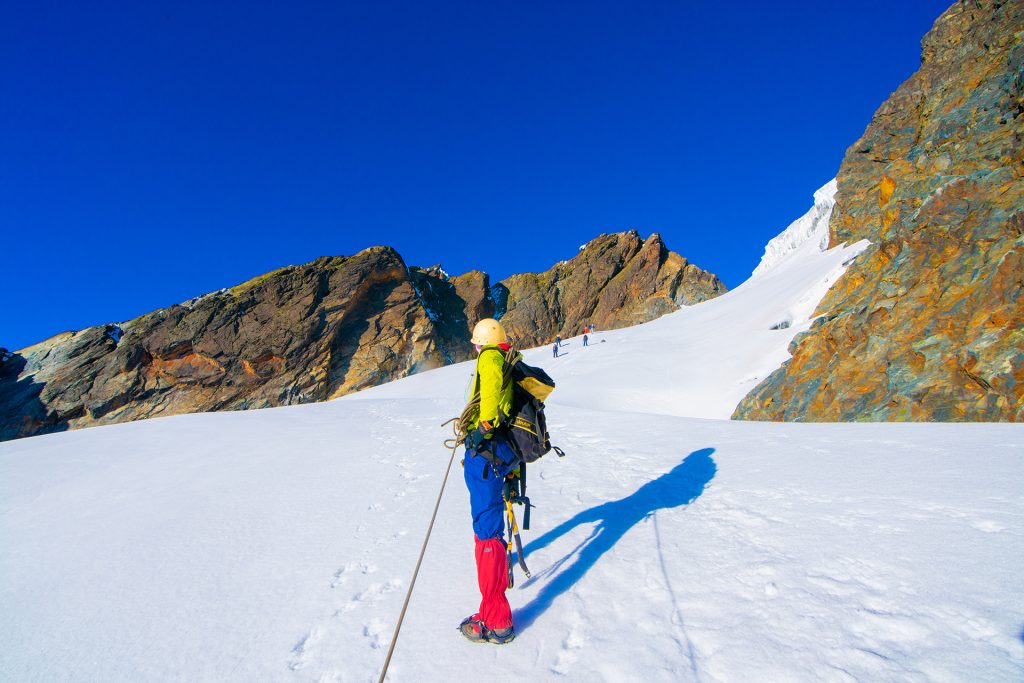
The Rwenzoris hold Margherita Peak at 5,109 metres, Africa’s third-highest point, and one of the few remaining equatorial glacier systems left on the continent, though these glaciers have retreated significantly and continue shrinking due to climate change.
The full summit circuit typically takes seven to nine days, involving genuine technical sections near the top requiring via ferrata equipment and basic climbing skills, alongside consistently muddy, boggy lower-altitude terrain that has earned the range a reputation as one of the more physically demanding treks in Africa, independent of the technical summit day itself.
Shorter three to four day itineraries exist for travellers who want a Rwenzori experience without committing to the full summit attempt, reaching lower peaks or scenic viewpoints without the technical glacier travel.
Practical implication: this is not a hike to attempt without proper preparation, a licensed guide, and realistic acclimatisation days built in; altitude and weather both change quickly at these elevations.
This is not a hike to attempt without proper preparation, a licensed guide, and realistic acclimatisation days built in; altitude and weather both change quickly at these elevations. Two main route options serve the range: the Central Circuit Trail, the more established and heavily used route with a network of mountain huts, and the Kilembe Trail, a quieter, less crowded alternative approaching from the range’s southern side, generally preferred by travellers who want a more solitary mountain experience even if it means slightly more basic overnight facilities along the way.
Mount Elgon
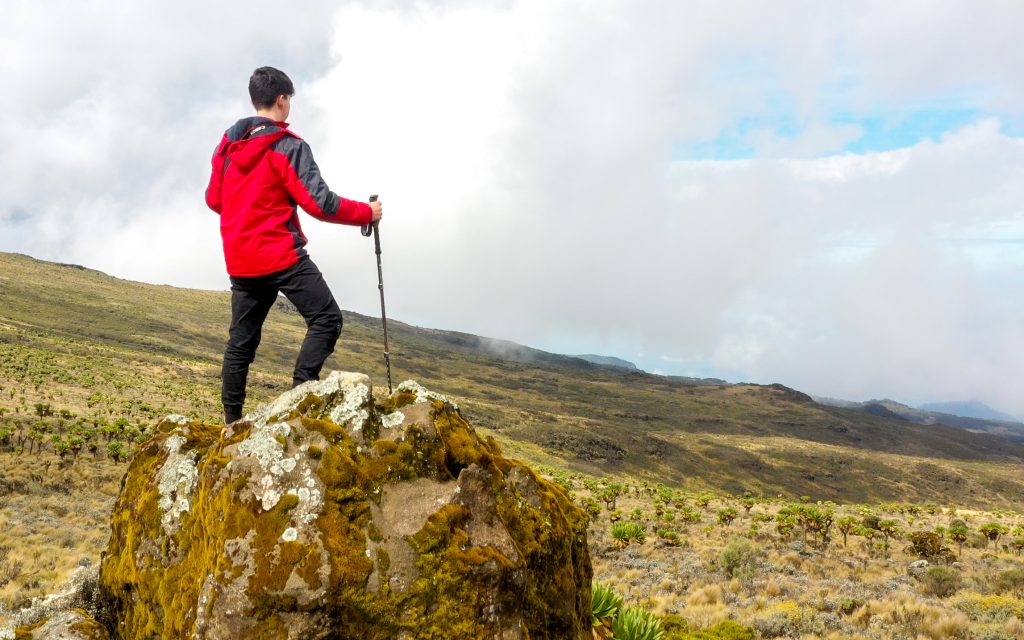
Mount Elgon, straddling the Uganda-Kenya border, is one of the largest volcanic bases in the world by surface area, though heavily eroded over millions of years into a distinctive caldera rather than a sharp peak. Hiking here means walking through montane forest, bamboo zones, and eventually high-altitude moorland dotted with giant lobelia and groundsel, genuinely different vegetation from anywhere else on this list.
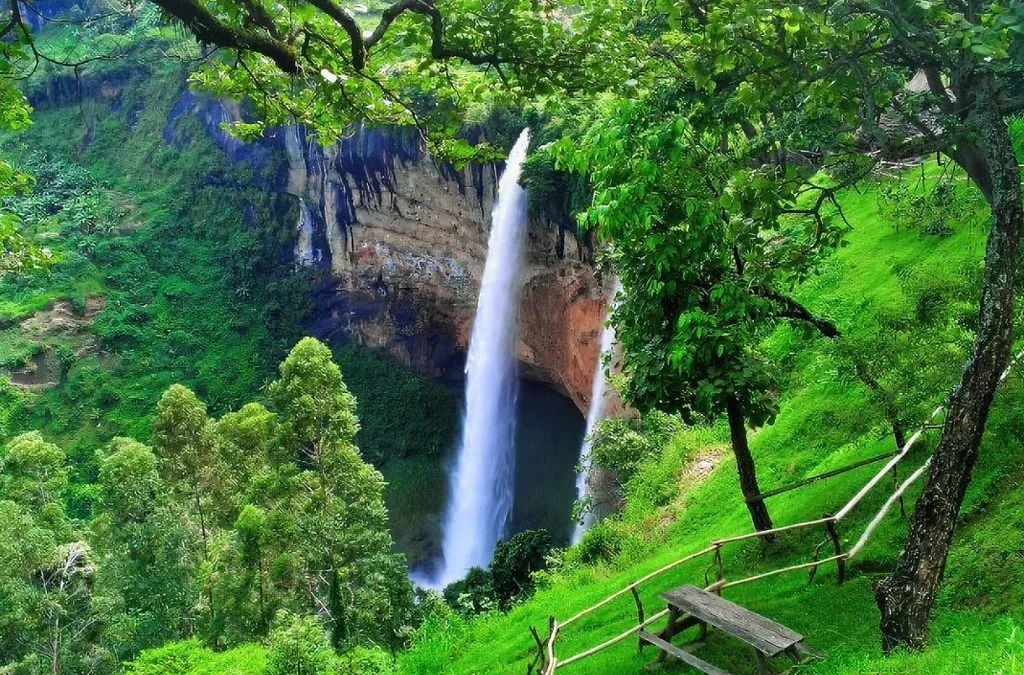
Sipi Falls, a three-tier waterfall on Elgon’s lower slopes, makes an excellent standalone half-day or full-day hike for travellers without time for the full mountain, while the multi-day routes to Wagagai Peak, Elgon’s highest point at 4,321 metres, and to the caves and hot springs within the caldera itself, suit travellers wanting a more serious multi-day trek without the technical demands of the Rwenzoris.
The Virunga Volcanoes at Mgahinga
Mgahinga Gorilla National Park, Uganda’s smallest national park, sits within the same volcanic range that extends into Rwanda and DR Congo, and offers three distinct single-day volcano hikes: Mount Sabinyo, Mount Gahinga, and Mount Muhavura.
- Mount Sabinyo: the most dramatic of the three, with a summit ridge that technically places you at the meeting point of Uganda, Rwanda, and DR Congo simultaneously, involving ladder sections near the top.
- Mount Gahinga: generally considered the easiest of the three, ending at a crater lake rather than a sharp peak.
- Mount Muhavura: the highest of the three at 4,127 metres, a steady, strenuous climb through moorland to a summit crater lake with views extending across the entire Virunga range on a clear day.
These hikes combine naturally with a gorilla trekking trip in the same park, giving travellers a physically active option for a second or third day in the area without needing to travel elsewhere.
Sipi Falls
Already mentioned as part of the Elgon system, Sipi Falls deserves its own specific mention because it works so well as a standalone, lower-commitment hiking destination for travellers without the time or inclination for a multi-day mountain trek. The area offers a network of trails connecting three separate waterfalls, ranging from an easy one to two hour loop to a fuller half-day circuit including abseiling and cave visits at some of the falls, run by local guiding operations.
Forest Walks in Bwindi and Kibale
Not every worthwhile Uganda hike involves an actual mountain. Both Bwindi Impenetrable Forest and Kibale Forest National Park offer maintained nature trails through dense rainforest, distinct from gorilla or chimpanzee trekking permits and priced considerably lower, focused on birdlife, forest flora, and general immersion in the ecosystem rather than a specific primate encounter.
These suit travellers who want genuine forest hiking without the cost or physical demand of a full primate trek, or who want a lower-key activity on a rest day between more strenuous hikes elsewhere.
Which Hike Suits Which Traveller
| Traveller Type | Recommended Hike | Reasoning |
| Serious mountaineer with 10+ days | Rwenzori full summit circuit | The only Uganda hike offering genuine glacier and technical climbing terrain |
| Fit hiker with 3 to 4 days | Rwenzori shorter itinerary or Mount Elgon multi-day route | Delivers a real mountain experience without the full two-week time commitment |
| Traveller combining hiking with gorilla trekking | Mgahinga volcano hikes | Same park, easily added to an existing Mgahinga gorilla permit itinerary |
| Family or casual walker | Sipi Falls | Manageable trails, scenic reward, minimal gear required |
| Wildlife-focused traveller wanting a lower-key walk | Bwindi or Kibale forest nature walks | Lower cost and physical demand than a full primate trek, still genuinely immersive |
What to Pack for Uganda’s Hiking Destinations
Gear needs differ sharply across these destinations, and packing for the wrong conditions is a common and avoidable mistake.
- Rwenzori Mountains: proper mountaineering boots, layered thermal clothing, a genuinely waterproof outer shell, gloves, and a warm sleeping bag rated for near-freezing temperatures at higher camps.
- Mount Elgon: sturdy hiking boots, warm layers for high-altitude moorland sections, and a reliable rain jacket given the caldera’s changeable weather.

Mount Elgon - Mgahinga volcanoes: hiking boots with good ankle support, gardening gloves for volcanic rock and vegetation, and layers for cool early morning starts.
- Sipi Falls: standard hiking shoes or trainers, a light rain jacket, and swimwear if you plan to explore the pools near the falls.
- Bwindi and Kibale forest walks: similar to gorilla trekking gear, waterproof boots, long trousers, and insect repellent given the forest environment.
When to Hike in Uganda
| Destination | Best Months | Why |
| Rwenzori Mountains | June to August, December to February | Driest conditions on notoriously muddy lower trails |
| Mount Elgon | June to August, December to February | Clearer visibility and firmer caldera trails |
| Mgahinga volcanoes | June to September, December to February | Aligns with the region’s two dry seasons |
| Sipi Falls | Year-round | Lower-altitude trails remain accessible in most conditions, though wetter months increase water flow at the falls themselves |
What to Budget For
| Destination | Approximate Cost | What’s Included |
| Rwenzori full summit circuit | $1,800 to $2,800 per person | Park fees, licensed guide, porters, mountain hut accommodation, meals |
| Mount Elgon multi-day trek | $500 to $900 per person | Park fees, guide, porters, camping |
| Mgahinga single volcano hike | $80 to $120 per person | Park entry, ranger guide |
| Sipi Falls half-day hike | $30 to $60 per person | Local guide fee, optional abseiling extra |
Planning Advice
- Match your hike to your available time, not just your fitness level. A strong hiker with only two spare days should choose Mgahinga or Sipi Falls over attempting a shortened Rwenzori itinerary that rushes acclimatisation.
- Book Rwenzori treks well in advance. Mountain hut capacity is limited, and licensed guides need advance notice to arrange porters for multi-day treks.
- Pack for genuinely different conditions across destinations. The Rwenzoris demand cold-weather gear and waterproof everything, while Sipi Falls needs little beyond normal hiking shoes and sun protection.
- Combine Mgahinga’s volcano hikes with your gorilla trekking days. This is the most time-efficient way to add serious hiking to an existing gorilla-focused itinerary.
- Consider a shorter Rwenzori itinerary if the full summit circuit is not realistic for your schedule. Three to four day options still deliver a genuine mountain experience without the two-week total commitment a full attempt plus recovery time requires.
Frequently Asked Questions
Do I need mountaineering experience for the Rwenzori Mountains?
For the full summit to Margherita Peak, yes, basic climbing competence and comfort with via ferrata equipment on glacier and rock sections is necessary. Shorter itineraries to lower peaks require good fitness but no technical climbing skill.
Is Mount Elgon harder than the Rwenzoris?
No, Mount Elgon is generally considered less technically demanding, though the multi-day routes still require solid fitness and proper preparation for high-altitude moorland conditions.
Can I hike in Uganda without joining a guided group?
All of Uganda’s major hiking destinations require a licensed guide, arranged through the relevant park authority or a registered operator, both for safety and because independent access is not permitted within these protected areas.
How difficult are the Mgahinga volcano hikes?
All three are strenuous single-day climbs, roughly six to eight hours round trip, requiring good fitness but no technical climbing skill, aside from ladder sections on Mount Sabinyo.
Is Sipi Falls suitable for families with children?
Yes, the shorter trail loops are manageable for most children with reasonable fitness, making it one of the more family-friendly hiking destinations on this list.
Which Rwenzori route should I choose, Central Circuit or Kilembe?
The Central Circuit Trail is better suited to first-time Rwenzori trekkers given its more established hut network and support infrastructure. The Kilembe Trail suits travellers who have done a Rwenzori-style trek before, or who specifically want a quieter route with fewer other hikers.
Are there hiking options in Uganda that do not require a park permit at all?
Yes, a number of community-run trails exist outside formal park boundaries, particularly around Sipi Falls and in the Rwenzori foothills, offering lower-cost half-day walks without the park entry fees that apply inside protected areas.
Choosing Your Uganda Hike
Uganda’s hiking destinations genuinely span the full range from an easy family afternoon at Sipi Falls to one of Africa’s most serious multi-day mountaineering routes at the Rwenzoris, and the right choice depends entirely on how much time and physical commitment you want to bring to the trip.
Most guests get the most value from combining a shorter, accessible hike, Sipi Falls or a Mgahinga volcano, alongside their wildlife-focused itinerary, rather than treating hiking and safari as separate trips entirely.
Related Posts