Gorilla Trekking in Uganda: Cost Per Person How much does gorilla trekking in Uganda actually…
Chimpanzee Trekking in Kibale Forest: The Complete Uganda Chimpanzee Safari Guide
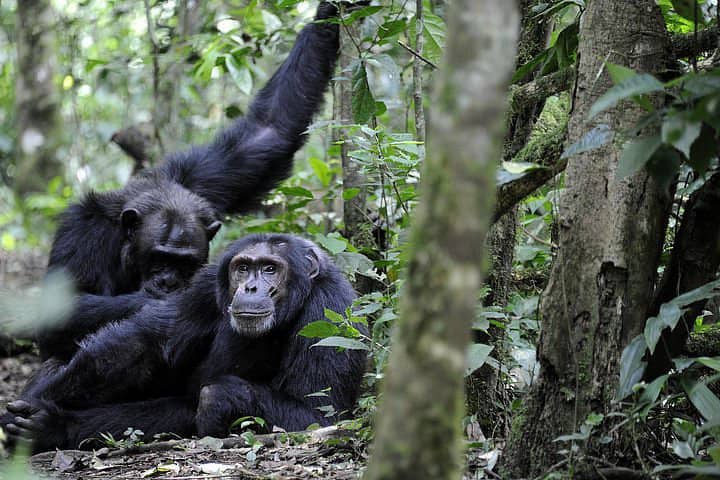
This is chimpanzee trekking in Kibale Forest.
Kibale National Park in western Uganda is widely regarded as the country’s leading destination for seeing wild chimpanzees. The park protects approximately 321 square kilometers of forest and is famous not only for its chimpanzees but also for an extraordinary concentration of other primates. Uganda Wildlife Authority describes the Kanyanchu Primate Walk as the park’s flagship wildlife experience, with 13 primate species possible during the walk.
The importance of Kibale extends well beyond tourism. Uganda’s latest State of Wildlife Resources report, released in 2026, estimates the country’s chimpanzee population at 6,075 individuals, up from 5,072 in the previous assessment. Recent site-specific surveys have also strengthened understanding of chimpanzee populations in several important forests, including Kibale.
For travelers however, the appeal is immediate and personal. You are not watching chimpanzees through a vehicle window. You are walking through their forest, following the signs they leave behind and listening for a community moving through the trees.
That difference is what makes a Kibale chimpanzee trek so memorable.
Why Is Kibale Forest the Best Place for Chimpanzee Trekking in Uganda?
Uganda has several forests where chimpanzees occur, but Kibale has become the country’s most established destination for chimpanzee tourism.
The park is located in western Uganda, near Fort Portal, in a landscape of rainforest, wetlands, crater lakes, farmland and rolling hills. Its forests form an important ecological connection with Queen Elizabeth National Park to the south.
Kibale’s particular strength is its concentration of primates.
Uganda Wildlife Authority currently estimates that Kibale supports more than 1,500 chimpanzees, distributed across at least 12 communities. Several communities have been habituated for research and tourism, while the Kanyantale community is the principal group associated with visitor tracking. The Kanyanchu chimpanzee program has operated since 1993, giving the area one of the longest-running chimpanzee tourism and research histories of its kind.
Chimpanzees are intelligent, highly social and naturally wary animals. They do not simply remain in one place waiting for visitors. Their movements change according to food availability, weather, social activity and territorial behavior.
Years of monitoring have allowed guides and researchers to understand individual communities, their preferred areas and their daily patterns.
Uganda Wildlife Authority currently reports a sighting success rate of more than 90 percent for the habituated Kanyanchu community. That does not mean every visitor is guaranteed a perfect encounter, but it explains why Kibale has such a strong reputation among travelers specifically interested in chimpanzees.
What Is Chimpanzee Trekking in Kibale Forest?
Chimpanzee trekking is a guided walk through Kibale’s forest in search of habituated chimpanzee communities.
Unlike a conventional safari, where a vehicle can cover large distances quickly, chimpanzee trekking is slower and more dependent on the forest itself.
Your guide and trackers look for clues. They listen for chimpanzee calls. They watch the canopy. They look for fresh feeding remains, nests, broken branches and other signs of recent movement. Experienced trackers also understand how the chimpanzees use different parts of the forest. The walk can be short or several hours long.
Uganda Wildlife Authority’s current Kibale information states that guided chimpanzee tracking walks generally take between two and five hours, depending on chimpanzee movements, weather and terrain. The current park information lists morning and afternoon tracking opportunities from the Kanyanchu Visitor Centre, while the formal 2024 tracking guidelines specify chimpanzee tracking sessions beginning at 8:00 in the morning and 2:00 in the afternoon.
Normal chimpanzee tracking allows visitors a maximum of one hour with the chimpanzees. The tracking itself can take considerably longer because the search and walking time are separate from the actual viewing period of one hour. That distinction is important when planning your day.
You are not booking an hour-long forest walk. You are booking a guided wildlife experience in which the chimpanzees determine where the group goes.
What Happens During a Chimpanzee Trek?
A typical morning begins at the Kanyanchu Visitor Centre.
Visitors register, meet their guides and receive a briefing before entering the forest. The briefing is not simply a formality. Chimpanzees are powerful wild animals, and their behavior can change quickly.
Once the group enters the forest, the pace becomes slower. The trail may pass beneath tall trees and through thick vegetation. There may be exposed roots, damp ground and sections where the path becomes muddy after rain. Then someone hears a hooting. The guide stops. Everyone listens.
Chimpanzee vocalizations can travel surprisingly far through the forest. A community may be feeding high in the canopy, moving across several sections of forest or gathering somewhere out of sight.
When the chimpanzees are finally located, the atmosphere changes. Cameras come out, but experienced guides usually encourage visitors to watch the animals before immediately concentrating on photography.
You may see grooming, feeding, resting, playing, travelling or social interactions. And then, after the permitted viewing period, the group leaves. The chimpanzees remain in the forest. That is an important part of responsible wildlife tourism.
Chimpanzee Tracking Versus the Chimpanzee Habituation Experience
One of the most common questions about chimpanzee trekking in Uganda concerns the difference between ordinary tracking and the Chimpanzee Habituation Experience.
They are not the same activity.
Standard Chimpanzee Tracking
Standard tracking is the option chosen by most safari travelers.
You join a guided group and search for an established /habituated chimpanzee community. Once the animals are located, the maximum viewing time is one hour. The experience is designed around finding and observing chimpanzees without spending an extended period with them.
The current Uganda Wildlife Authority tariff for July 2024 through June 2026 lists the Kibale chimpanzee tracking permit at:
- 250 United States dollars for foreign non-residents
- 200 United States dollars for foreign residents
- 180,000 Ugandan shillings for East African Community citizens
The tariff states that the Kibale tracking rate includes the guide and park entrance for the day, and that chimpanzee tracking also includes the nature walk on the day of tracking.
Because tariffs operate for specific periods, travelers should verify the applicable rate when booking rather than assuming that an older price remains current indefinitely.
Chimpanzee Habituation Experience
The Chimpanzee Habituation Experience is designed for travelers who want considerably more time in the forest with chimpanzees.
Under the current Uganda Wildlife Authority guidelines, the experience allows a maximum of four hours of viewing, compared with one hour for normal tracking. The activity begins earlier, at 6:30 in the morning, and involves accompanying researchers and habituation teams as they work with chimpanzees that are less accustomed to human presence.
The current 2026 tariff lists the Kibale Chimpanzee Habituation Experience at:
- 300 United States dollars for foreign non-residents
- 250 United States dollars for foreign residents
- 250,000 Ugandan shillings for East African Community citizens
The tariff states that the rate includes the guide and park entrance and provides four hours with the chimpanzees.
Which Experience Should You Choose?
For a first Uganda safari, standard chimpanzee tracking is usually enough.
For wildlife photographers, primate enthusiasts, researchers or repeat visitors, the habituation experience offers something different. Four hours allow you to observe changing behavior rather than experiencing a single concentrated encounter.
You may see the chimpanzees wake, feed, travel, groom, call and interact socially. It is a much deeper immersion into their daily lives.
How Much Does Chimpanzee Trekking in Kibale Cost?
For the current July 2024 to June 2026 Uganda Wildlife Authority tariff period, Kibale chimpanzee tracking costs 250 United States dollars for foreign non-residents, 200 United States dollars for foreign residents and 180,000 Ugandan shillings for East African Community citizens.
The Chimpanzee Habituation Experience costs 300 United States dollars for foreign non-residents, 250 United States dollars for foreign residents and 250,000 Ugandan shillings for East African Community citizens under the same tariff. These figures refer to the official activity tariff rather than the cost of an entire safari.
A complete Kibale trip may also include:
- Accommodation
- Transport
- Meals
- Driver-guide services
- Additional park activities
- Community experiences
- Birdwatching
- Transfers between destinations
Travelers should also distinguish between a chimpanzee permit and the broader safari package sold by a tour operator. The permit is the authorization to participate in the activity. Transport, accommodation and other services are separate unless specifically included in the package.
What Is the Minimum Age for Chimpanzee Trekking in Kibale?
Current Uganda Wildlife Authority information for Kibale states that visitors participating in chimpanzee tracking must be at least 14 years old. It also recommends advance booking because the experience has limited spaces. The age requirement is understandable when the nature of the activity is considered.
Chimpanzee trekking involves walking through a forest, sometimes for several hours, while following wild animals. Trails can become slippery and muddy, and chimpanzees can move quickly through dense vegetation.
Younger travelers can still enjoy the Kibale region through other activities, including guided nature experiences and the wider primate and wetland attractions around the forest. Families planning a Uganda safari should therefore check age requirements before building the itinerary around chimpanzee tracking.
What Are Kibale’s Chimpanzees Like?
Chimpanzees are not simply smaller versions of humans living in trees. They have complex societies, shifting alliances, territorial relationships and highly developed communication systems.
A chimpanzee community can contain many individuals, and the social relationships between them are constantly changing.
Chimpanzee Social Life
Grooming is an important social activity. Individuals may sit together and carefully pick through each other’s fur. Young chimpanzees play. Adults form relationships and alliances. Males may travel together while patrolling the edges of their territory.
Recent research highlighted by Uganda Wildlife Authority from more than 30 years of work at Ngogo in Kibale has documented aggressive interactions between neighboring chimpanzee communities, including encounters involving coalitions of adult males.
This is one reason experienced guides do not treat chimpanzee trekking as simply an exercise in finding an animal. They are reading behavior. A chimpanzee sitting quietly in a tree tells one story. A group suddenly moving in the same direction, calling loudly, tells another.
Chimpanzee Communication
One of the most memorable sounds in Kibale is the chimpanzee pant-hoot. The call can begin with one animal and spread across the community. For visitors, it can feel as if the forest is answering itself.
Guides who spend years around the chimpanzees learn to recognize different calls and understand what they may indicate.
What Do Chimpanzees Eat?
Fruit is an important part of the diet, but chimpanzees are flexible feeders.
They consume leaves, flowers, seeds and other plant material and can also eat insects and animal matter. Uganda Wildlife Authority notes that chimpanzees can occasionally supplement their diets with meat, including other primates.
Food availability affects movement. A fruiting tree can hold a community in one area, while changing food conditions may send the chimpanzees deeper into the forest. This is one reason a chimpanzee trek can never be completely predictable.
When Is the Best Time for Chimpanzee Trekking in Kibale?
Chimpanzee tracking is available throughout the year. The traditional distinction between dry and rainy seasons needs some qualification because Kibale’s chimpanzees do not follow a tourist calendar.
Uganda Wildlife Authority specifically notes that chimpanzee tracking can be particularly rewarding during the rainy season, even though the trails can become muddy. During drier periods, chimpanzees may move deeper into the forest while searching for food.
Dry Season
The advantages include:
- Generally easier walking conditions
- Less persistent mud
- Comfortable conditions for forest exploration
- Good opportunities to combine chimpanzee trekking with other western Uganda activities
The disadvantage is that chimpanzees may sometimes move farther into the forest in search of food.
Rainy Season
Rain transforms Kibale.
The vegetation becomes intensely green, the forest feels cooler and the atmosphere can be dramatic.
The trails can be muddy, but rainfall does not mean the chimpanzee experience is automatically worse. Uganda Wildlife Authority identifies the rainy season as a particularly favorable period for tracking, despite the walking conditions.
For serious wildlife travelers, the best approach is to choose a season based on the overall safari rather than assuming that a dry month guarantees a better chimpanzee sighting.
What Is the Kanyanchu Area of Kibale Forest?
Kanyanchu is the principal tourism hub for chimpanzee trekking in Kibale. It is where visitors meet guides, receive their briefing and begin the forest experience. The area is also significant because of its long history of chimpanzee monitoring.
According to Uganda Wildlife Authority, the Kanyanchu chimpanzee community has been intensively monitored and habituated to human presence since 1993. That long-term relationship between researchers, guides and chimpanzees is one of the reasons the area can provide such consistent viewing opportunities.
The official tracking guidelines identify Kanyanchu among the designated entry points for habituated chimpanzee tracking in the Uganda Wildlife Authority-managed protected areas. Advance booking is recommended, especially during busy safari periods.
What Else Can You See While Doing Chimpanzee Trekking?
Kibale is not a one-animal destination. The chimpanzees may be the headline attraction, but the surrounding forest contains an extraordinary collection of other wildlife. Uganda Wildlife Authority records more than 120 other mammal species in the park and approximately 370 bird species.
Other Primates
Possible sightings include:
- Red colobus
- Black-and-white colobus
- L’Hoest’s monkey
- Grey-cheeked mangabey
- Red-tailed monkey
- Olive baboon
The red colobus and black-and-white colobus can be particularly striking when they move through the upper canopy.
Forest Elephants
Kibale also supports forest elephants. They are much harder to see than savannah elephants because the forest is dense and their movements can be elusive. Uganda Wildlife Authority lists Kibale among the Ugandan forests where forest elephants occur.
Seeing one is never something to build the itinerary around, but it is a remarkable bonus when the forest provides the opportunity.
Birds
Birdwatchers can turn a chimpanzee trip into a much broader forest safari.
Kibale supports approximately 370 bird species, including Albertine Rift species and forest specialists. The forest environment is particularly rewarding for travelers who are willing to spend time looking beyond the large mammals including the thought after Green-breasted Pitta among other Albertine rift endemics recorded.
What Does a Typical Chimpanzee Trekking Day Look Like?
A typical tracking day begins early. You have breakfast at your lodge before heading to Kanyanchu. After registration and briefing, you meet the guides and enter the forest. The first part of the walk may seem deceptively quiet.
There are birds calling overhead. Leaves move in the breeze. Insects hum in the vegetation. Then the guide pauses. The group listens. The chimpanzees may be several hundred meters away. The walk continues.
Eventually, the calls become stronger. The trackers move ahead. The group follows carefully. Then comes the moment everyone has been waiting for. A chimpanzee emerges from the canopy.
Perhaps it is feeding. Perhaps it is grooming another individual. Perhaps it is staring down at the visitors before disappearing behind leaves. The permitted one hour viewing period passes quickly. Eventually the group begins the walk back.
The forest remains just as alive as before, but the experience has changed your sense of it. The trees are no longer simply scenery. Somewhere among them is a complex chimpanzee society that was there before you arrived and will remain after you leave.
What Should You Wear and Pack for Chimpanzee Trekking?
Kibale is a rainforest, so practical clothing matters more than safari fashion.
Clothing
Wear:
- Long trousers
- A lightweight long-sleeved shirt
- Comfortable hiking shoes or boots
- A lightweight waterproof jacket
- Socks suitable for walking
- A hat or cap
Long clothing provides useful protection against vegetation, insects and wet conditions.
Equipment
Bring:
- Binoculars
- Camera
- Extra camera batteries
- Waterproof protection for electronics
- Small backpack
- Drinking water
- Insect repellent
- Personal medication
- A lightweight rain layer
A waterproof bag or dry bag is especially useful during wet weather. Kibale can become muddy, and a pair of shoes that are comfortable on uneven ground is more valuable than footwear chosen purely for appearance.
How Difficult Is Chimpanzee Trekking in Kibale?
Chimpanzee trekking is manageable for most reasonably active travelers, but it should not be mistaken for an easy nature walk.
The forest floor is uneven. Roots cross trails. Slopes rise and fall. Rain can make the ground slippery. The chimpanzees themselves determine the route, meaning a relatively short morning can occasionally become a longer walk.
Uganda Wildlife Authority states that typical tracking walks can last between two and five hours depending on chimpanzee movements, weather and terrain.
Fitness therefore matters. Travelers with limited mobility should discuss their circumstances with their safari operator before booking. For most visitors who are comfortable walking for several hours over uneven ground, the trek is achievable.
The bigger challenge is often patience. You may walk for a while without seeing anything obvious. That is not wasted time. You are learning how to read a forest.
How Good Are the Chances of Seeing Chimpanzees?
The chances are excellent in the habituated Kanyanchu community. Uganda Wildlife Authority currently reports a sighting success rate of more than 90 percent. That is among the strongest reasons to choose Kibale for a Uganda chimpanzee safari.
Chimpanzees are wild. They can move, hide, travel through thick vegetation or remain high in the canopy. Weather can affect tracking conditions. Food availability can influence where communities spend their time. The most useful mindset is therefore to value the encounter rather than demand a particular photograph.
Chimpanzee Trekking and Conservation in Uganda
Chimpanzee trekking exists within a much larger conservation story.
Uganda’s 2026 State of Wildlife Resources report estimates approximately 6,075 chimpanzees nationwide, an increase from 5,072 in the earlier assessment. The report emphasizes that recent surveys and continued monitoring are important because chimpanzee populations occur across multiple forest ecosystems and isolated forest fragments.
Kibale is central to this effort. The forest provides habitat for one of Uganda’s largest chimpanzee populations, while decades of research have created an unusually detailed understanding of chimpanzee behavior.
Uganda Wildlife Authority identifies accidental snaring as a major threat within national parks and central forest reserves. Chimpanzees can also face habitat loss, human-wildlife conflict and disease risks where forests meet human settlements.
Disease deserves particular attention. Chimpanzees are genetically close to humans, which means some diseases can move between people and great apes. Uganda Wildlife Authority notes research from Kibale showing similarities between some chimpanzees and nearby human gut parasites.
That is why visitor behavior is not merely about protecting tourists. It protects the chimpanzees as well.
The Science Behind Kibale’s Chimpanzees
Kibale has become one of the world’s important locations for long-term primate research.
Researchers are not simply visiting the forest for a few weeks and recording what they happen to see. Long-term projects have followed individual chimpanzees, communities and social relationships across decades.
In 2026, Uganda Wildlife Authority highlighted more than 30 years of research into chimpanzee social behavior at Ngogo in Kibale National Park. The research has helped document complex social structures and aggressive interactions between neighboring communities.
For visitors, this scientific background adds depth to what they see. A group of chimpanzees grooming in a tree is not simply a beautiful wildlife scene. It is part of a sophisticated social system that researchers have spent decades trying to understand.
Where to Stay for Chimpanzee Trekking in Kibale
Location matters because an early start is easier when the forest is nearby.
Near Kanyanchu
This is the most convenient choice for travelers whose primary purpose is chimpanzee trekking.
Being close to the visitor center reduces the morning transfer time and makes it easier to prepare for an early start.
Near Bigodi
Bigodi is useful for travelers who want to combine chimpanzee trekking with a community or wetland experience.
The area provides a natural extension to a Kibale itinerary rather than simply a place to sleep.
Fort Portal
Fort Portal works well for longer western Uganda journeys.
The city can be combined with crater lakes, tea landscapes and other attractions before or after Kibale.
Kibale can be reached from Kampala by the Kampala–Fort Portal highway, with the park approximately 326 kilometers from Kampala and about six hours by road under normal traffic conditions. From Fort Portal city, the park is approximately 50minutes drive from the city center.
How to Get to Kibale Forest
By Road
For most safari travelers, road travel is the most practical option.
From Kampala, the route passes toward Fort Portal before continuing to Kibale. The road journey can form part of the safari rather than simply being transportation between destinations. Travelers coming from Queen Elizabeth National Park can also incorporate Kibale into a western Uganda circuit.
By Air
Domestic flights can shorten the journey considerably.
Uganda Wildlife Authority notes that travelers can fly from Entebbe International Airport or Kajjansi Airfield toward Kasese, followed by a road transfer to Kibale. Chartered flights to Fort Portal are another possibility.
The best option depends on the wider itinerary, budget and number of travelers.
Chimpanzee Trekking Itinerary Ideas
For travelers with more time, Kibale can become part of a wider western Uganda journey.
A longer itinerary can combine:
- Kibale chimpanzee trekking
- Queen Elizabeth National Park
- Kyambura Gorge
- Bwindi Impenetrable National Park
- Gorilla trekking
- Forest birding
- Community experiences
The result is a journey through several very different ecosystems rather than a single wildlife destination.
Chimpanzee Trekking in Kibale Versus Kyambura Gorge
Uganda offers more than one opportunity to track chimpanzees.
Kibale is the country’s best-known destination, while Kyambura Gorge in Queen Elizabeth National Park provides another established experience.
| Feature | Kibale Forest | Kyambura Gorge |
| Main destination | Kibale National Park | Queen Elizabeth National Park |
| Primary attraction | Chimpanzees and exceptional primate diversity | Chimpanzees within a gorge and forest setting |
| Setting | Extensive tropical forest | Forested gorge within a savannah landscape |
| Best for | Travelers specifically interested in chimpanzees | Travelers combining chimpanzees with a classic safari |
| Other wildlife | Extensive primate diversity and forest species | Strong combination with Queen Elizabeth wildlife and boat safari |
Uganda Wildlife Authority’s current guidelines identify both Kibale’s Kanyanchu and Queen Elizabeth’s Kyambura as designated chimpanzee tracking locations.
If chimpanzees are the central purpose of your trip, Kibale is the natural first choice. If you are already spending several days in Queen Elizabeth National Park, Kyambura can be a valuable addition.
Responsible Chimpanzee Trekking Rules
The quality of a chimpanzee encounter depends partly on how visitors behave.
- Follow the guide’s instructions.
- Maintain the required distance.
- Do not feed chimpanzees.
- Do not attempt to touch them.
- Do not call them closer for photographs.
- Do not leave food or rubbish in the forest.
- Avoid sudden movements when the animals are nearby.
- Most importantly, do not treat habituated chimpanzees as tame animals. Habituation means chimpanzees have become accustomed to the presence of people. It does not mean they have lost their wild instincts;
A 2025 incident involving a chimpanzee that had moved into a human settlement illustrated the risks of close interaction. Uganda Wildlife Authority and the Jane Goodall Institute/Kibale Chimpanzee Project subsequently relocated the animal for safety and reminded the public that chimpanzees remain powerful and unpredictable wild animals.
- Visitors should also avoid trekking when experiencing a potentially transmissible illness. Protecting great apes sometimes means keeping a respectful distance even when you would prefer to be closer.
Is Chimpanzee Trekking in Kibale Worth It?
For travelers interested in wildlife, primates and natural history, chimpanzee trekking in Kibale is one of Uganda’s defining experiences.
The attraction is not simply the likelihood of seeing a chimpanzee, but the setting. You enter a mature tropical forest where the wildlife is often hidden. You learn to listen for movement above you. You follow the clues left by animals that may have been living in that landscape long before humans arrived.
For a few minutes, the distance between observer and observed seems surprisingly small. A chimpanzee looks toward the group. Another moves through the branches. A mother carries her young. The community begins to travel again. And eventually, you leave. The forest closes behind you, and the chimpanzees continue their day.
That is the essence of chimpanzee trekking in Uganda. It is not a performance arranged for visitors. It is an opportunity to enter, briefly and respectfully, a living forest society.
Kibale’s combination of a substantial chimpanzee population, long-term research, habituated communities, exceptional primate diversity and established tourism infrastructure makes it the country’s standout destination for this experience. The latest national conservation figures, showing Uganda’s chimpanzee population at approximately 6,075, make the importance of protecting these forests even clearer.
For anyone planning a Uganda safari, Kibale deserves more than a passing stop, but deserves time and presence.
Frequently Asked Questions About Chimpanzee Trekking in Uganda
How much does chimpanzee trekking cost in Uganda?
For Kibale National Park, the Uganda Wildlife Authority tariff for July 2024 through June 2026 lists chimpanzee tracking at 250 United States dollars for foreign non-residents, 200 United States dollars for foreign residents and 180,000 Ugandan shillings for East African Community citizens.
How much is a chimpanzee permit in Kibale Forest?
The current published Kibale chimpanzee tracking permit is 250 United States dollars for foreign non-residents, 200 United States dollars for foreign residents and 180,000 Ugandan shillings for East African Community citizens for the July 2024 to June 2026 tariff period.
What is the minimum age for chimpanzee trekking in Kibale?
Uganda Wildlife Authority’s current Kibale visitor information states that chimpanzee trackers must be at least 14 years old.
What is the best time to trek chimpanzees in Uganda?
Chimpanzee trekking takes place throughout the year. Uganda Wildlife Authority notes that the rainy season can be particularly rewarding for tracking, despite muddy trails, while chimpanzees may move deeper into the forest during drier periods in search of food.
How long does chimpanzee trekking in Kibale take?
A normal trek generally takes between two and five hours, depending on chimpanzee movements, weather and terrain. Once the chimpanzees are found, normal tracking allows a maximum of one hour of viewing while chimpanzee habituation experience allows four hours of viewing.
How many chimpanzees are in Kibale Forest?
Uganda Wildlife Authority currently estimates that Kibale supports more than 1,500 chimpanzees distributed across at least 12 communities.
How many chimpanzees are there in Uganda?
Uganda’s 2026 State of Wildlife Resources report estimates approximately 6,075 chimpanzees nationally.
What is the difference between chimpanzee tracking and habituation?
Normal chimpanzee tracking provides a maximum of one hour of viewing once the chimpanzees are found. The Chimpanzee Habituation Experience provides up to four hours and involves following chimpanzees alongside researchers and habituation teams.
Is chimpanzee trekking difficult?
The difficulty varies. Trails can be muddy and uneven, and the chimpanzees may move through challenging terrain. Uganda Wildlife Authority says typical tracking walks last between two and five hours.
What should I wear for chimpanzee trekking?
Wear comfortable hiking shoes or boots, long trousers, a long-sleeved shirt and a lightweight waterproof jacket. Bring protection for your camera and other electronics because Kibale can receive rain throughout the year.
Can chimpanzee trekking be combined with gorilla trekking?
Yes. Kibale can be combined with Bwindi Impenetrable National Park or Mgahinga Gorilla National Park as part of a longer western Uganda great ape safari.
Is Kibale better than Kyambura for chimpanzee trekking?
For travelers whose primary goal is chimpanzee trekking, Kibale is generally the stronger choice because of its large chimpanzee population, established habituated communities and long history of chimpanzee research and tourism. Kyambura is particularly convenient for travelers already exploring Queen Elizabeth National Park and have less time. Uganda Wildlife Authority recognizes both areas as chimpanzee tracking destinations offering a great experience.
Related Posts