How Gorilla Trekking Benefits Conservation How Gorilla Trekking Benefits Conservation; With a population of just…
Ultimate Guide to Ngorongoro Crater Safari Experience
Ultimate Guide to Ngorongoro Crater Safari Experience
Guide to Ngorongoro Crater Safari Experience; Standing on the rim of the Ngorongoro Crater early in the morning feels like some amazing moments in the famous animation films. The air up here is unusually chilly, with an unusual smell of moist earth and high altitude moss. You find yourself standing by the cold wooden railing of the viewpoint, wearing your fleece jacket, and watching a thick opaque blanket of fog covering the ridge. The vibe at the viewpoint feels very solid and tangible, as if there is a theatre curtain drawn over the landscape.
Underneath that thick white layer is a 100 square mile volcanic bowl, a prehistoric caldera containing about 25,000 large mammals completely isolated from the rest of East Africa. The complete silence prevailed initially in the surrounding region. Gradually, you hear the nasal grunt of an invisible wildebeest or the rumbling sound of a throat clearing of some distant lion coming straight from the fog.
Once the sun rises above the eastern highlands, the magical transformation happens. The golden rays hit the rim and begin to peel off the fog, revealing the bright savannah plains lying far below. From this height, giant bull elephants appear as little dark pebbles moving across the plains and Lake Magadi sparkles as if it was made of mercury.
It is a fully self-sufficient world, a natural amphitheater where the cycle of life unfolds in front of your eyes. However, since this paradise is literally fenced by walls, it becomes a heavily regulated environment. Outsmarting the crowd, navigating the steep one way tracks and understanding the intricate permit structures become an inevitable part of your trip. In order to explore the geological wonders of the place without much hassle, you need to understand how the caldera breathes.
In order to comprehend the dynamics of how the day inside the caldera works, you need to distinguish between the general landscape and the caldera itself. Tourists commonly use the term “Ngorongoro” interchangeably, referring to both the crater and the broader landscape. Nevertheless, the Ngorongoro Crater is merely one particular landmark located in the immense 8,000 square kilometer Ngorongoro Conservation Area.
This impressive geographical formation serves as a huge geographical link that connects the precipices of the Great Rift Valley escarpment with the endless short grass plains of the eastern Serengeti. When you are booking your game drive, you will concentrate your attention on a narrow strip of this landscape, namely, the caldera floor.
As mentioned above, the crater is the world’s largest intact, unfilled volcanic caldera, a giant, bowl shaped depression formed when a huge volcano exploded and collapsed millions of years ago. The size of this bowl is the key factor determining all of your guide’s decisions regarding the day inside the caldera.
The floor is located on an altitude of about 1,800 meters, while the rim, where the lodges are placed, reaches 2,200 meters above sea level. The difference of 400 meters is sheer, covered by forests and reachable only by several steep, unpaved tracks. It means that this geographical phenomenon created two totally different climate zones.
While you may freeze in the morning at 06:00 on the rim, in the middle of the day on the exposed savannah floor below, the sun beats directly and heats up very fast. Packing for a day inside the caldera requires preparation for both montane highland forest and dry East African savannah within a twenty minute drive.
Cost of Ngorongoro Crater Experience
The Ngorongoro Conservation Area functions according to the strictly controlled conservation system, where various fees are applied. If you are booking a safari, you can leave this problem to your operator. However, understanding the details of how things function is crucial.
Budgeting for Ngorongoro is totally different from estimating the expenses on national parks. The conservation area has a very complex, hierarchical administrative structure and understanding the layers of fees is extremely important. If you are booking the trip via a safari operator/travel agent, these items will be included in the final invoice. Nevertheless, knowing them will give you an opportunity to estimate your expenses better.
First of all, there is the Conservation Entry Fee, controlled by the Ngorongoro Conservation Area Authority. Contrary to the standard flat rate entry fees charged by many national parks, the Conservation Entry Fee is the basic tariff needed in order to pass the geographical boundaries of the conservation area.
For international adults aged 16 and older, the fee is 70.80 USD per person per single entry into the crater, taking into account the 18 percent VAT imposed by the government of Tanzania. For families travelling with children aged 5 to 15, the fee amounts to 23.60 USD per child. Toddlers under five are free.
The geographical peculiarity of northern Tanzania creates what the local guides call the “transit trap”. The case is that in case your desired itinerary includes the road trip from Arusha to the endless plains of the Serengeti, you will inevitably follow the main road running along the rim of the Ngorongoro Crater.
Since the Ngorongoro Conservation Area Authority is an independent entity from Tanzania National Parks, which manages the Serengeti National Park, passing through this gate pipeline means that you will be obliged to pay the full conservation entry fee at Lodoare Gate.
Even if you do not intend to visit the crater floor and use the tarmac road only as a highway to Naabi Hill Gate, you will not be able to avoid this basic fee. Moreover, since this charge is based on a single entry, revisiting this geographical area within the next two days from Serengeti national park will cost you the same amount of money.
- The Crater Service Fee
Once you pay the basic Conservation Entry Fee, you will face the major challenge of the day, getting down onto the crater floor. As the crater is considered a fragile, premium environment, the authority charges 295 USD per vehicle descending on the floor. It is not a day pass for the vehicle. It is a onetime descent fee.
In case you or your driver decides to come back up for lunch and wants to descend in the afternoon, you will have to pay 295 USD once again. Since this fee is based on the vehicle, not on the passengers, the calculations may be beneficial or disastrous depending on your choice of transportation.
In case you are travelling as a couple and renting a private vehicle, you will pay the descent fee alone, meaning 147.50 USD per person, just for having the tires of your car on the crater floor. This does not include fuel costs, guide fee, or individual entry ticket.
The smart planning of your trip implies opting for a shared safari vehicle or joining a small group of four or five people. In this case, the descent fee will be split equally among all passengers in the vehicle. Thus, this particular item of expenses will amount to about 73.75 to 59 USD per person respectively.
When you estimate the costs of your trip to Tanzania, this choice between a private and shared vehicle is the major factor that influences your daily spending.
- Nightly Concession Fees
The last item on the list of hidden fees related to the conservation area is the nightly concession fee. If you choose to stay in a lodge or tented camp located inside the conservation boundaries, such as those built along the rim of the crater, the authorities will charge an additional 71 USD per adult every night.
It is basically an overnight bed tax that helps preserve the unique highland ecosystem of the area. In case a family of three spends three nights in one of these lodges, you will pay an extra 530 USD for accommodation alone.
Understanding this fee helps you realize the benefits of choosing a different location for your accommodation. In case you pick a boutique hotel in the Karatu Highlands, located outside the main gate of the conservation area, you will avoid this additional charge.
The climate there is also warmer and more comfortable. You will enjoy the atmosphere of coffee farms and quieter guesthouses while getting better value for money. If you prefer sleeping with a direct view of the caldera, you will need to include this additional nightly fee in your budget.
Where to Sleep
Where you stay during the night before your safari determines your morning routine. Basically, you have two options.
Option A: Staying on the Crater Rim
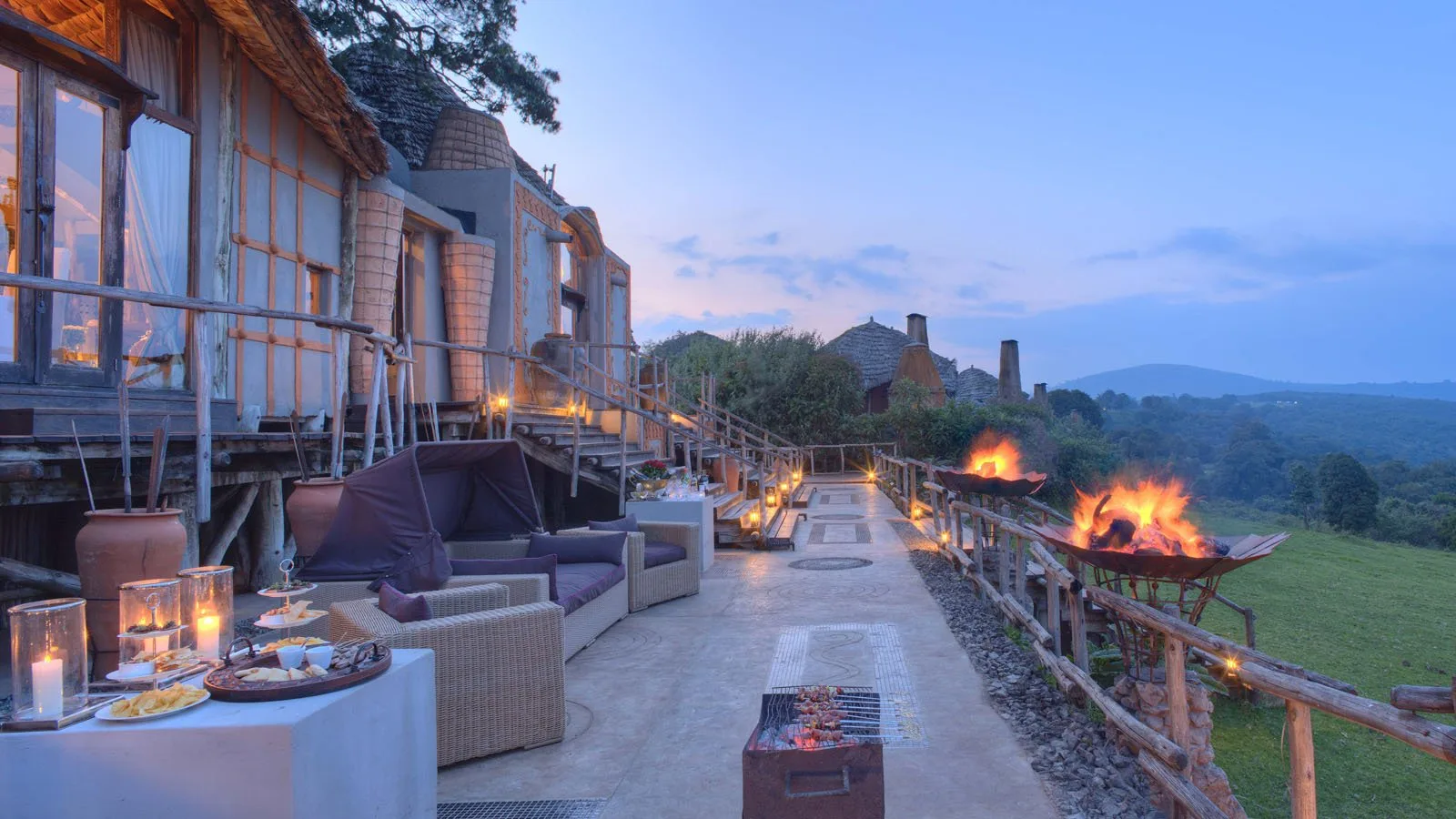
Lodges and camps built directly on the high rim of the crater provide stunning views right outside your window.
Pros:
You will start the day close to the action. It takes only a few minutes to drive to the descent gate.
Cons:
Staying at the rim means paying the additional 71 USD concession fee every night. The altitude also means cold mornings and evenings, so warm clothes are necessary. Some larger lodges can also feel crowded.
Option B: Staying in Karatu Highlands
The town of Karatu, located outside the main Lodoare Gate, is surrounded by green hills and coffee plantations.
Pros:
Staying outside the conservation area saves you the concession fee. The weather is warmer, the accommodation feels more personal, and prices are usually better.
Cons:
You will miss the crater views and will need to add a 30 to 60 minute drive to the conservation gate in the morning.
If you stay in Karatu, waking up early is important. Try to reach the gate around 06:00 to avoid larger tour groups arriving later in the morning.
Ngorongoro Crater Wildlife Dynamics
Once you leave the thick forest along the descent road and reach the crater floor, it feels like entering a wildlife documentary. The dense montane forest suddenly opens into a wide plain covered with short volcanic grass.
The steep 600 meter caldera walls act like a natural enclosure, which means the animals inside live differently from those on the Serengeti plains. There is no need for long migrations because fresh water and mineral rich grass are available all year.
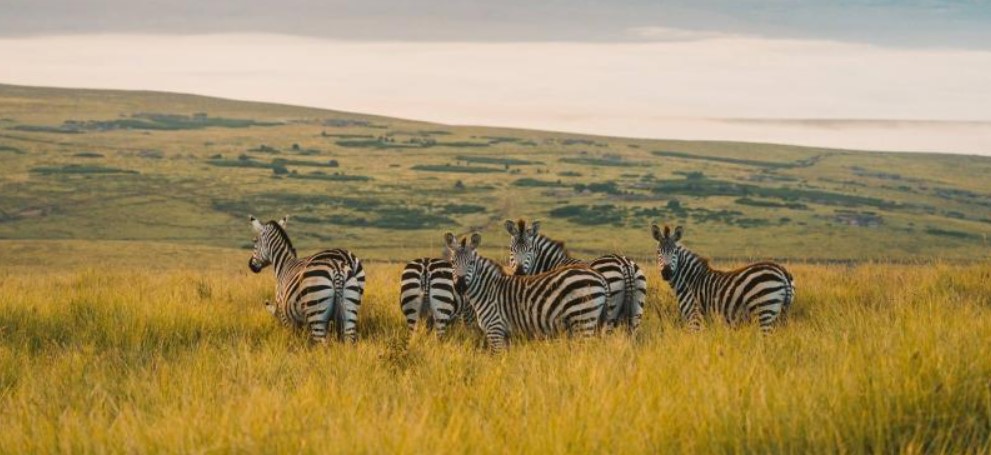
Most of the estimated 25,000 large mammals remain here permanently. The wildebeests and zebras grazing near Lake Magadi today are often the same ones seen months later in the same area. Since they do not migrate, territorial competition becomes intense.
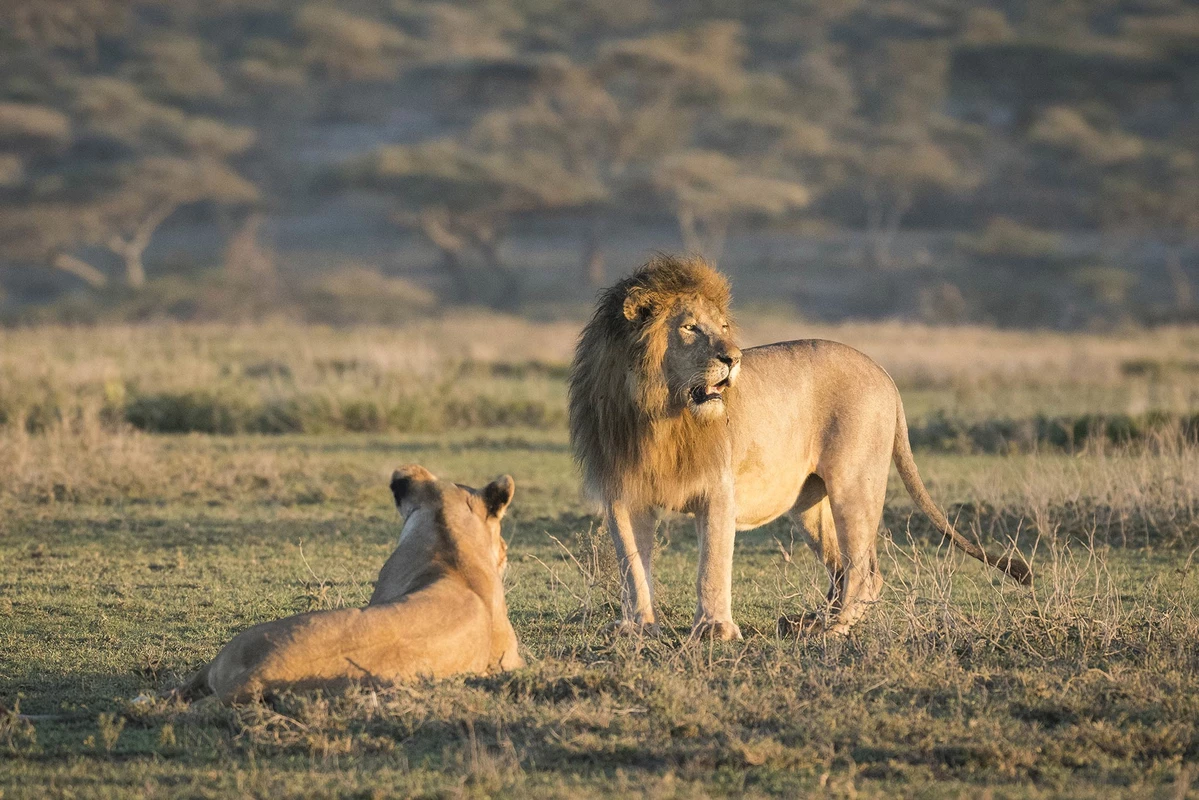
The crater has one of the highest predator densities in Africa. Lions and spotted hyenas constantly compete for space and food. Unlike Serengeti lions that follow moving herds across long distances, Ngorongoro lions remain in smaller territories, which increases the chance of witnessing hunts or confrontations.
The Rhino Stronghold
The crater remains one of the few places in East Africa where visitors still have a realistic chance of seeing the critically endangered black rhinoceros. Roughly 30 to 40 black rhinos live on the crater floor.
They usually graze in open plains during the morning and move into the shade of Lerai Forest during the hottest hours of the day. The forest edges are often the best place to look for them.
Predators and Ecosystem Balance
The concentration of lions and spotted hyenas here is among the highest on the continent. Because food is relatively abundant and territories are compact, interactions between predators happen regularly.
You will also see large numbers of wildebeests, zebras, Thomson’s gazelles, and old male elephants often called “super tuskers”. These older bulls spend time in the swampy parts of the crater where softer vegetation is easier to feed on.
Ngorongoro Crater Rules and Regulations
To protect the fragile ecosystem, strict rules are enforced across the crater floor.
No off road driving:
Vehicles must stay on designated dirt tracks. This rule protects the volcanic soil from erosion. If an animal is away from the road, you must observe it from your vehicle using binoculars or a zoom lens.
Vehicle limit:
Only five vehicles are allowed at one wildlife sighting at the same time. Experienced guides usually manage this well and may wait nearby until space becomes available.
Noise control:
Sound travels far across the flat crater floor. Keeping your voice low helps avoid disturbing wildlife and preserves the experience for others nearby.
Packing List for Ngorongoro Crater
Versatile clothing:
Expect large temperature changes during the day. Early mornings on the rim are cold enough for a windbreaker and fleece, while afternoons on the crater floor are often warm enough for a simple shirt.
Plastic restrictions:
Tanzania has strict regulations against single use plastic bags. Make sure your luggage does not contain them before entering the conservation area.
Dust protection:
During the dry season, roads inside the crater become extremely dusty. A scarf or face covering is very useful, especially when other vehicles pass by.
Conclusion
Ngorongoro Crater rewards patience and careful timing more than rushed schedules. It is a compact ecosystem where small decisions, such as arriving early or choosing the right season, shape the entire experience.
If you reach the gate at dawn, understand the changing conditions of the crater, and accept that you will share the roads with other safari vehicles, the rewards are unforgettable. This is not just another game drive. It is an opportunity to enter an ancient volcanic basin that has supported its own wildlife system for millions of years.
With proper planning and realistic expectations, you can descend from the misty forested rim onto the crater floor and experience one of the most remarkable wildlife landscapes anywhere in Africa.
Related Posts