Uganda is the choice if you have ever dreamed of standing a few feet away…
Best Destination for Wildebeest Migration
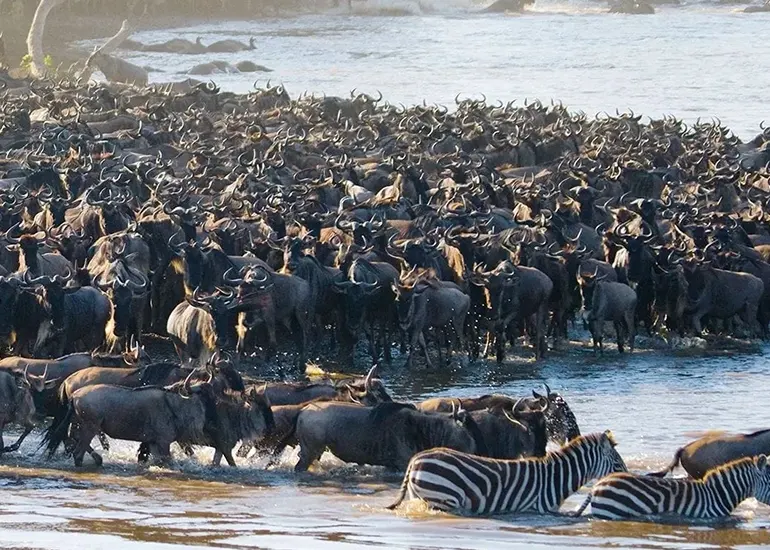
The Great Wildebeest Migration is the largest overland animal movement on the planet, a circular journey of survival that spans the Serengeti-Mara ecosystem. The great migration happens annually in Kenya and Tanzania. You can enjoy the great wildebeest migration in Kenya or Tanzania depending on the month of the year you choose to travel.
The scenes will never leave your mind; a golden horizon under a relentless sun, a cloud of dust rising like smoke, and the rhythmic, noise of two million animals on the move. This is a pilgrimage.
As a local Safari Planner who has spent over a decade tracking these herds, this exhaustive guide is to help you know “where,” “when,” and “how” of the great wildebeest migration in the Maasai Mara or Serengeti.
- Why Do Wildebeests Move?
To understand where the wildebeest are going, you have to understand what drives them. It’s not wanderlust; it’s a desperate search for phosphorus and nitrogen…! Yes it is.
The Serengeti’s volcanic soil is rich in these minerals, which are essential for lactating mothers and growing calves.
The entire 800-kilometer (500-mile) circuit is dependent on the rainfall patterns of East Africa. When the rains fail in one area, the herds move to the next “green patch.”
The great Wildebeest Migration is a movement of three groups; the “lawnmowers” of the Savannah, followed closely by the “gardeners” (zebras, who eat the taller, tougher grass) and the “opportunists” (lions, leopards, and hyenas).
The Symbiotic Trio
You will rarely see wildebeests alone. They travel in a massive “mixed bag”:
- The Wildebeest (The Engine): Nearly 1.5 million of them. They have a “water nose” and can smell rain from 50 kilometers away.
- The Zebra (The Scout): About 200,000 join the trek. Zebras have better eyesight and memory than wildebeests, acting as the “security guards.”
- The Thompson’s Gazelle (The Tag-along): Around 350,000 follow behind, eating the short shoots left over by the larger grazers.
This group of three distinct herbivores, can easily be called the symbiotic trio.
- The 2026 Migration Calendar: Where to be Month-by-Month
Nature never cares about our calendars, but these wildebeests are creatures of habit. And through the habits, a calendar movement is followed year after year in the great Mara plains. Here is the most likely path for 2026.
January – March: The Miracle of Ndutu (The Great Calving Season)
If you are looking for the heartbeat of the Great Migration, this is the most soulful and raw time to be on safari in Tanzania. During these months, the massive herds of wildebeests, gazelles and zebras, settle on the famous short-grass plains of the Southern Serengeti and the Ndutu region, which sits right on the border of the Ngorongoro Conservation Area.
- The Phenomenon: This is the world’s biggest “baby shower.” In a wild burst of life during February, about 500,000 wildebeest calves are born in just a short three week window. That is nearly 8,000 new babies every single day! Safari experience gets better when you see a wobbly calf stand up and run within minutes of being born is a true “Circle of Life”, this is how unforgettable a safari in east Africa can be.
- The Predator Action: Where there are babies, there are hunters. This is Prime Predator Season. Do not feel bad about the predatory actions, it is also called life balance in the great plains of Africa. Because the calves are easy targets, big cats like lions, leopards, and the world-famous Serengeti cheetahs gather in huge numbers. During this Tanzanian Great Migration safari, it is a must to see the high-speed drama of hunting.
- Where to Stay: It is great to know where to stay during this safari, even though your safari planner must offer the best options for your budget. Lake Ndutu Luxury Tented Lodge or one of the many Mobile Migration Camps. These “under canvas” camps are specially designed to move with the animals, ensuring you wake up exactly where the action is happening.
April to May: The Long Rains and the Green Secret of the Maara Savannahs.
This season of the great migration is also the low season of safaris in east Africa. As the short grass plains in the south start to dry up, the Great Migration begins its long march toward the North West. This is the most underrated time of the year, often called the Green Season, and it is a total hidden gem for travelers who want the Serengeti all to themselves.
- The Great migration safari Vibe: The dust of the dry months is completely gone, washed away by the Long Rains. The air is crystal clear and the entire landscape turns into a glowing emerald green. While some lodges close because the roads get muddy and others cut off by flooded roads, the lodges that stay open offer massive discounts and luxury at an affordable price.
- The Low season Phenomenon: Because the grass is lush and there are very few tourists in the plains, the animals are incredibly relaxed. You will see huge mega herds of zebras, and gazelles grazing peacefully against a backdrop of dramatic African skies. The low season African safaris will feel like a private paradise where you are the only person watching the Circle of Life unfold.
- Local Tip: This is the absolute golden era for photography on an African safari journey. If you want that National Geographic shot, this is it. The contrast of dark, moody storm clouds against the bright green grass and the golden coats of lions and leopards is breathtaking. Plus, with no dust in the air, your colors will pop like never before. Just do not forget to pack your best camera.
- Where to Stay: Look for permanent luxury lodges in the Central Serengeti or the Western Corridor. Since the ground can be soft, staying in a lodge with solid stone foundations like the Four Seasons Safari Lodge or Serengeti Serena Safari Lodge ensures you have all the comfort while the rain falls on the roof.
June to July: The Western Corridor and the Grumeti River
This is the best season for your hot air balloon Safari experience in Tanzania. As the weather dries out, the Great Migration shifts into the Western Serengeti. This part of the journey is where the animals face their first real life or death challenge: the Grumeti River. It is a rugged and wild area that has less foot traffic from tourists, making it a favorite for those who want a raw experience.
- The Drama: While the Grumeti River is not quite as wide as the Mara River, it is just as dangerous. The Grumeti River is home to massive Nile crocodiles that have been waiting patiently for months for the herds to arrive. Watching a million wildebeest try to cross these waters while dodging giant crocodiles is a heart pounding sight that reminds you just how tough survival is in the African bush.
- The Phenomenon: This time of year is also known as the Rut, which is the wildebeest mating season. The plains are absolutely packed with energy as noisy, aggressive males fight each other for territory and the right to mate. It is a loud, dusty, and high energy spectacle that fills the air with a unique sound you will only hear in the Serengeti.
- Local Fact: Because the Grumeti River often breaks into smaller pools during the drier months, it can trap fish and hippos in small areas. This creates a unique ecosystem where you can see lions, leopards, and crocodiles all competing for the same space.
- Where to Stay: This is the perfect time to stay in the Western Corridor. If you want a bit of luxury with your adventure, look into the Grumeti Serengeti River Lodge or the Kirawira Serena Camp. These spots are famous for their old world safari charm and being right in the middle of the action.
August to September: The Iconic Mara River Crossings and the Great Migration Kenya Safari Experience
This is the peak of the Great Migration in Kenya and Tanzania, the legendary scene you have seen in every nature documentary, reference to NATGEO WILD. By late August, the mega herds of the symbiotic trio reach the Northern Serengeti and begin their desperate attempt to cross into the Maasai Mara National Reserve. This is widely considered the most dramatic wildlife spectacle on the planet.
- The Crossings: The Wildebeests, and the gang in the symbiotic trio, gather in what your safari guides call staging areas on the riverbanks. They might wait for several days, nervous of the deep water and the predators hiding beneath the surface, until one brave leader finally takes the leap of faith. Once that first wildebeest jumps, it is pure, splashing chaos. Seeing thousands of animals plunging into the water at once is a heart stopping moment that defines the African safari experience.
- The Predator Action: Because the Mara River is the ultimate bottleneck, it is a prime hunting ground. You will see massive Nile crocodiles waiting in the currents and large lion prides lurking in the thickets on the other side. This is the best time for a hot air balloon safari activity where you get to see the real Big Five sightings as the predators take full advantage of the migrating herds.
- The Reality Check: Because this is the most famous part of the Great Migration, it can get crowded. You will see other safari vehicles lined up to watch the action. To escape the crowds and get better photos, your guide MUST look for hidden crossing points like rather than the main crossing near the Serena area.
- Where to Stay: For the best access to the river, look at Mara Serena Safari Lodge or Governors Camp in Kenya. On the Tanzania side, Sayari Camp in the Kogatende region offers an incredible front row seat to the action.
October to November: The Short Rains and the Return South
Once the lush grass in the Kenya’s Maasai Mara has been grazed down to the roots, the animals begin to sense the change in the weather. The short rains in the south start to beckon them back toward the Serengeti National Park.
- The Journey Back: The herds turn around and begin a rapid trek through the Eastern Serengeti. Unlike the slow move north, this return journey is often much faster as the animals are eager to reach the fresh, nutrient rich grass in the south before the next calving season begins.
- The Experience: This is a fantastic time for a Tanzania safari because the crowds have mostly gone home, but the wildlife is still incredibly active. The landscape is starting to bloom again with the first rains, providing a beautiful backdrop for seeing the migration herds on the move.
- Local Tip: This is a great window for travelers looking for a more affordable trip. Many lodges drop their rates in November, but you still get to see the massive movement of animals as they head toward the southern plains.
- Kenya vs. Tanzania: The Great Migration Debate
Deciding between a Maasai Mara safari in Kenya and a Serengeti safari in Tanzania is the most common dilemma for every traveler. While both offer a front row seat to the Great Migration, the experience on the ground is very different. Here is the breakdown to help you choose the right side for your adventure.
The Case for Tanzania: The Vast Serengeti National Park
The Serengeti is nearly ten times the size of the Mara, covering about fourteen thousand seven hundred and fifty square kilometers. It is a land of endless plains and massive horizons.
- Pros: You get a true sense of infinite space. Because the Great Migration stays within Tanzania for about nine months of the year, you have a much wider window of time to see the herds. It feels wilder, more remote, and often more exclusive because the wild animals are spread out over such a huge area.
- Cons: The driving distances are very long. It can easily take six hours to move from one region of the park to another. If you do not like spending long hours in a safari vehicle, you might want to consider flying between the different airstrips.
- Best For: Travelers who want a deep, immersive nature experience and have at least a week to explore the different zones of the park.
The Case for Kenya: The Iconic Maasai Mara
The Maasai Mara is effectively the northern tip of the Serengeti ecosystem. It is much smaller, covering about one thousand five hundred and ten square kilometers.
- Pros: The wildlife density is incredible. Because the park is compact, you can often find the Big Five (lion, leopard, elephant, buffalo, and rhino) and the migrating herds all in a single morning drive. It is generally more budget friendly than Tanzania and very easy to access from Nairobi.
- Cons: During the peak months of August and September, the traffic can be intense. Near the main river crossing points, you might find yourself sharing a sighting with many other vehicles.
- Best For: Travelers who are short on time or want to see the highest concentration of animals in the shortest possible window.
The Private Conservancies
If you choose Kenya but want to avoid the crowds, here is the best tip from a local tour operator: stay in a Private Mara Conservancy like Mara North or Olare Motorogi. These are lands owned by the local Maasai people and leased to small, high end safari camps.
By staying here, you get the amazing animal density of the Mara but with very strict vehicle limits. This means you will not have twenty cars at a single lion sighting, and you can enjoy unique activities like night game drives and guided bush walks that are not allowed in the main national reserve.
Whether you pick the vast plains of Tanzania or the action packed hills of Kenya, you are assured of the greatest natural wonders of the world. Many travelers are even choosing to combine both countries into one “Combo Safari” to see the full cycle of the African wildlife migration.
- Safari Styles: Where to stay during your wildebeest migration safari?
Your choice of accommodation will completely define your travel experience. In modern day, the biggest trend in travel is moving toward low impact and high immersion stays that get you closer to the land.
- The Mobile Tented Camp: This is the choice for true eco- friendly travelers. These camps are packed up and moved three times a year to follow the movement of the Mega Herds/ great migration symbiotic trio. While they are technically temporary, do not let the word tent fool you. We are talking about luxury levels and four course meals served under the stars. You will wake up to the sound of thousands of wildebeests grazing right outside your canvas walls.
- The Luxury Permanent Lodge: If you prefer solid walls and a bit more infrastructure, places like the Four Seasons Serengeti or Angama Mara are world class. These are great for families with younger children who might need a break from the dust. You get access to swimming pools, gyms, and even professional wine cellars in the middle of the bush.
- The Adventure Fly in Safari: Instead of spending eight hours on bumpy dirt roads, which locals often call an African massage, you can hop on a small twelve seater bush plane. This is the best way to maximize your time and see the true scale of the Great Migration from the air.
- Essential Logistics for your East African Safari adventure
Planning a trip to East Africa requires some paperwork, but it is much easier if you know the rules ahead of time.
- Entry Requirements: For Kenya, you now need an Electronic Travel Authorization. You must apply for this online at least two weeks before you fly. For Tanzania, most travelers need a Visa. While you can get one on arrival, I always recommend the e-Visa to avoid long queues at the airport.
- Health and Safety: If you are crossing the border between Kenya and Tanzania, you must show proof of a Yellow Fever vaccination. Also, remember that these are malarial zones, so talk to your doctor about the best medicine to take.
Local Safety: You are perfectly safe inside the parks with your guide. When you are in cities like Nairobi or Arusha, its equally safe for one to move or even walk by themselves however, exercise some degree of caution like anywhere else in the world, avoid carrying
Related Posts